You've probably seen the beautiful marbled coasters, terrazzo-style trays, and concrete-look planters popping up everywhere — on social media, in craft studios, and in boutique homeware shops. Most of them are made with the same material: jesmonite.
But what actually is jesmonite? And why has it become the go-to material for so many makers and creatives?
What Is Jesmonite?
Jesmonite is a composite material made from two components: a mineral-based powder (typically gypsum) and a water-based acrylic resin. When mixed together, they form a pourable, mouldable material that cures into a solid with the look and feel of stone, concrete, or plaster — but with added durability and flexibility.
It was first developed in the United Kingdom in 1984 by Peter Hawkins, and has since become a staple in fine arts, architecture, film set design, and — more recently — the booming craft and homeware scene.
Unlike traditional resins (like polyester or epoxy), jesmonite is water-based, low in VOCs (volatile organic compounds), and solvent-free. That means it's safer to work with, doesn't release harmful fumes, and cleans up with just water. For hobbyists and professional makers alike, that's a huge deal.
How Is Jesmonite Made?
Jesmonite comes as a two-part kit:
- A reactive mineral base — a fine powder, usually gypsum or a cementitious blend
- A water-based acrylic liquid — the polymer that binds everything together
To use it, you measure the liquid and powder in a specific ratio (typically 2.5:1 base to liquid by weight for AC100), mix them with a high-shear mixing blade until smooth, add pigment if desired, and pour into a silicone mould. The material sets in about 15–20 minutes and reaches full strength after 24 hours.
The mixing process is straightforward, but there are a few tips to get the best results:
- Always measure by weight for accuracy — don't estimate
- Mix slowly to minimise air bubbles
- Add pigment to the liquid first for even colour distribution
- Use a high-shear mixing blade designed for jesmonite to ensure a smooth, lump-free mix
What Types of Jesmonite Are There?
Jesmonite isn't a single product — it's a range. The two most relevant types for crafters are:
AC100 — The Craft Favourite
Jesmonite AC100 is the original product and the most popular choice for beginners and hobbyists. It's an acrylic-modified gypsum composite that replicates fine surface detail beautifully. It's perfect for making coasters, trays, jewellery, decorative plates, vases, and other homeware items.
AC100 is designed for internal use. If you're making coasters or decorative items that will live indoors, this is the one you want.
AC730 — The Concrete Look
Jesmonite AC730 is an acrylic-modified cementitious composite that contains decorative aggregates to achieve concrete and stone surface finishes. It's externally durable, UV-stable, and non-combustible, making it ideal for outdoor planters, architectural features, and larger projects.
AC730 is available in several pre-mixed stone finishes — Natural Stone, Bath Stone, White Marble, Silver Grey Granite, and more — each with its own unique aggregate texture.
Why Has Jesmonite Become So Popular?
Several factors have driven jesmonite's explosion in the craft world:
It's Eco-Friendly
Jesmonite is water-based and solvent-free, with low VOC emissions. It doesn't release toxic fumes during mixing or curing, and cleanup requires only water. For makers who care about sustainability, it's a clear winner over traditional petroleum-based resins.
It's Beginner-Friendly
You don't need a studio, special ventilation, or expensive equipment to work with jesmonite. A kitchen table, a digital scale, a mixing blade, and some silicone moulds are enough to get started. The material is forgiving, sets quickly, and the results are immediately satisfying.
It's Incredibly Versatile
Jesmonite accepts pigments to any colour reference, and can mimic virtually any texture — stone, concrete, metal, wood, leather, and more. Add metal powders for a brushed bronze finish, mix in glitter for sparkle, or pour multiple colours for a marbled effect. The creative possibilities are genuinely endless.
It's Durable
Cured jesmonite is resistant to cracking, chipping, and impact. It has excellent compressive and tensile strength, and when sealed, it becomes waterproof. A jesmonite coaster isn't just decorative — it can handle daily use.
Jesmonite vs Resin: What's the Difference?
Many people wonder how jesmonite compares to epoxy or polyester resin. Here's a quick breakdown:
| Feature | Jesmonite | Epoxy Resin |
|---|---|---|
| Base | Mineral powder + water-based acrylic | Petroleum-based polymer |
| Toxicity | Low VOC, solvent-free, no fumes | Can release harmful fumes, requires ventilation |
| Cleanup | Water | Acetone or solvents |
| Look & Feel | Stone, concrete, matte finishes | Glossy, glass-like, transparent |
| Durability | Impact-resistant, chip-resistant | Can yellow with UV exposure, may crack |
| Setting Time | 15–20 minutes | 12–72 hours |
| Best For | Coasters, trays, planters, terrazzo effects | River tables, encapsulation, glossy finishes |
Jesmonite and resin serve different purposes. If you want a glossy, glass-like finish or need to encapsulate objects, resin is your material. If you want the look of stone or concrete with a matte, tactile finish — and a safer, more eco-friendly process — jesmonite is the way to go.
What Can You Make with Jesmonite?
Almost anything that can be cast or moulded. Popular projects include:
- Coasters — the most popular beginner project. Pour, set, sand, done.
- Trays and dishes — functional art for your kitchen or bathroom
- Planters and vases — concrete-look pieces without the weight
- Jewellery — earrings, pendants, and bracelets with a stone finish
- Soap dishes and candle holders — practical and beautiful
- Decorative terrazzo — mix chips of coloured jesmonite for a speckled effect
- Wall art and sculptures — lightweight and durable
The material is especially popular for creating terrazzo and marble effects, where multiple colours are swirled together to create unique, one-of-a-kind patterns. No two pieces ever look the same.
Do You Need to Seal Jesmonite?
It depends on the product and the use case. Jesmonite AC100 is slightly porous and benefits from a sealer if the finished piece will come into contact with water or liquids (like coasters). Jesmonite AC730 is less porous due to its cementitious base, but sealing is still recommended for outdoor use or staining protection.
A good quality jesmonite sealer will provide an invisible protective layer without changing the look or feel of the surface. For food-contact items, always use a food-safe sealer.
Frequently Asked Questions About Jesmonite
Is jesmonite safe to use at home?
Yes. Jesmonite is water-based, non-toxic, and produces no harmful fumes. It's safe to use in your kitchen or living room without special ventilation. Just wear gloves and a dust mask when mixing the powder to avoid inhaling fine particles.
How long does jesmonite take to dry?
Jesmonite sets in approximately 15–20 minutes at room temperature, but it takes 24 hours to reach full strength. It's best to demould after the initial set and leave the piece to cure fully before sanding or sealing.
Can jesmonite be used outdoors?
AC100 is designed for internal use and should be sealed if used externally. AC730 and AC630 are formulated for external durability and can be used for outdoor planters, water features, and architectural elements.
Is jesmonite waterproof?
Jesmonite AC100 is porous and absorbs moisture unless sealed. AC730 has lower permeability but still benefits from a sealer for prolonged water exposure. Once sealed, jesmonite becomes effectively waterproof.
Can I add colour to jesmonite?
Absolutely. Jesmonite accepts pigments to any colour reference. Add up to 2% pigment by weight of the total mix for solid colours, or use less and swirl for a marbled effect. You can also mix in metal powders, glitter, or aggregate chips for terrazzo.
Ready to Try Jesmonite?
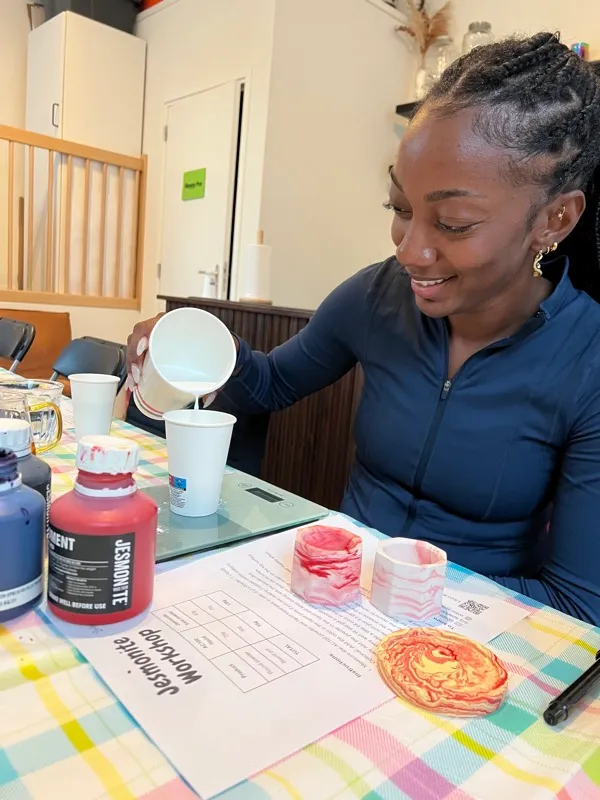
The best way to learn is by doing. At Sparkling Mosaic, we run a hands-on Coaster & Mini Jar Making workshop in Amsterdam where you'll learn to work with jesmonite, create your own marbled coasters, and walk out with beautiful pieces you made yourself.
No experience needed. We provide all materials, guidance, and plenty of creative inspiration.
Book the Coaster & Mini Jar workshop or arrange a private session for your group.